Goals for the Week

Well, returning to work has been tough on my energy level and general motivation. As in, I didn’t get anything done this week.

In part this is due to general disorganization (and a stupidly large amount of stuff on my non-writing to-do list that I just don’t feel like handling… leading to copious amount of time wasted on the Internet.)

There’s one cure for that: an OFFICIAL TO-DO LIST!

So, by next Monday, I must:

1-Write 500 words on Book the Second. That’s a ridiculously low bar. But it’s a reasonable target given the rest.

2-Finish the last details I wanted to do on the Book the Second tech bible. That’s just copying manuscript notes into the Word document, so it’s a “whenever I have time” task.

3-Another Bonus Creativity post. I already know what it will be about, so it should be a couple of hours top.

4-Review my agent list – just basic maintenance work, again a matter of minutes.

5-Formalize my notes on e-publishing, and plan my blog post(s) on the matter.

Five goals. The passing grade is 3/5, but completing task 1 is mandatory. Let’s see how well I’ll do.

Back to Work

All good things come to an end. My paternity leave ends today, and so I must head back to work.

(Full disclosure, I have an easy first week, so don’t pay too much attention to my whining.)

So – did I do everything I wanted on my vacation?

1-Blogging:

Almost made it. In fact, I have another post already written up so technically I did everything I wanted there.

2-Writing:

Total, abject failure. I was more tired than I thought, but the real kicker was how exhausting being at home with the baby for entire days could be. Once I got past the initial sleep-twelve-hours-a-day period of my vacation, I had some time off in the evening, but my brain just wasn’t there.

And when I finally found energy again, well, we instead decided to put that energy to socialize a bit.

The good news is we now have a start date for daycare. So starting in June I should have prime quality time at home without the baby.

Now that the excuses are over… I did manage to work on the support documentation for Book the Second. Solved my main plot issue for the series, drew the world map, and even got started on the synopsis. But actual word count only went up by a few hundred (although I did get through a tough scene, so there’s that.)

3-Querying:

On track with what I wanted to do, but no movement on that front. Still, it’s not because I didn’t do my part, so I call this a win!

4-E-publishing:

I did some research. Surprisingly easier than I thought, but I still need to do more and write that post.

5-Other projects:

Started on some of the projects I had in mind (that’s the “in reserve” post), also stumbled into surprise projects that could generate me some money. So another net positive here.

So that’s what I did on my vacation.

Bonus Creativity: Drilling Down

Let’s get some more work done on our hex maps, before I return to work.

Last time, we created the broad outline of the game world. Now, I want to skip down to the fine details of the starting area for our eventual game.

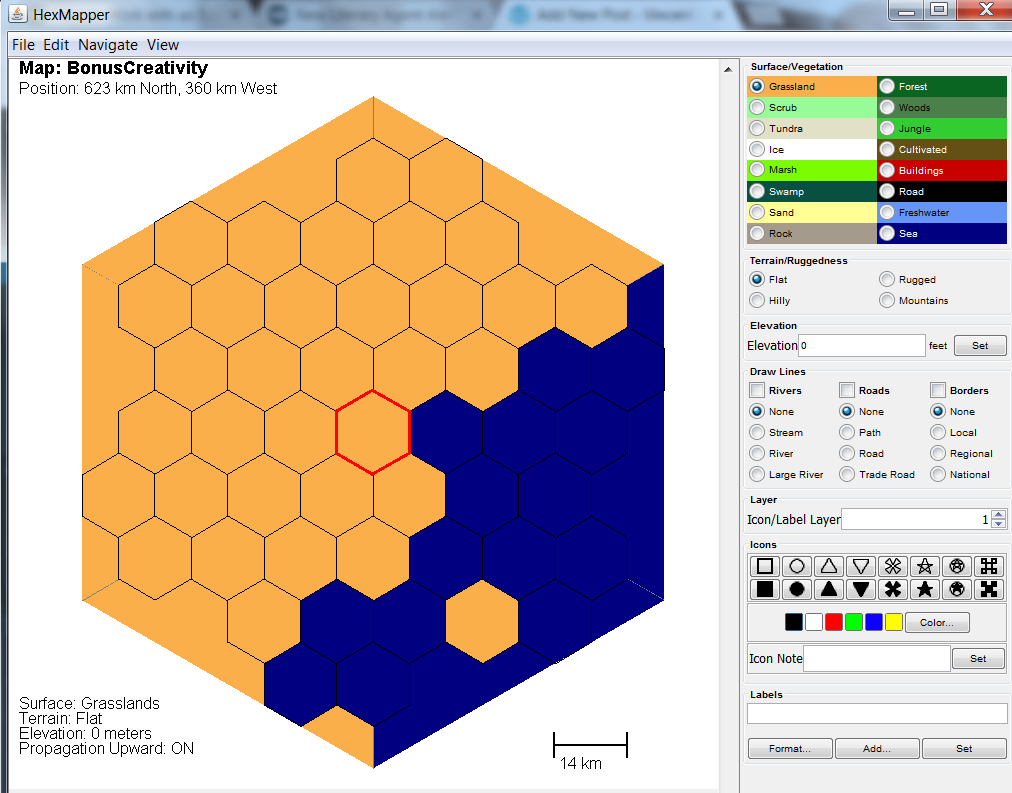
So… let’s work on this hex there:

ENHANCE! (and do some landscaping work, I guess)

ENHANCE! (with extra work just to make a nice coastline)

There we go. 14km hexes are small enough to allow for some worldmap-level detail (in general, I’ll only go smaller for hexes of interest.) As a rule of thumb, I figure players will cross one hex of practicable terrain in a half-day, or of rough terrain in a day.

So what do we want in our starting area?

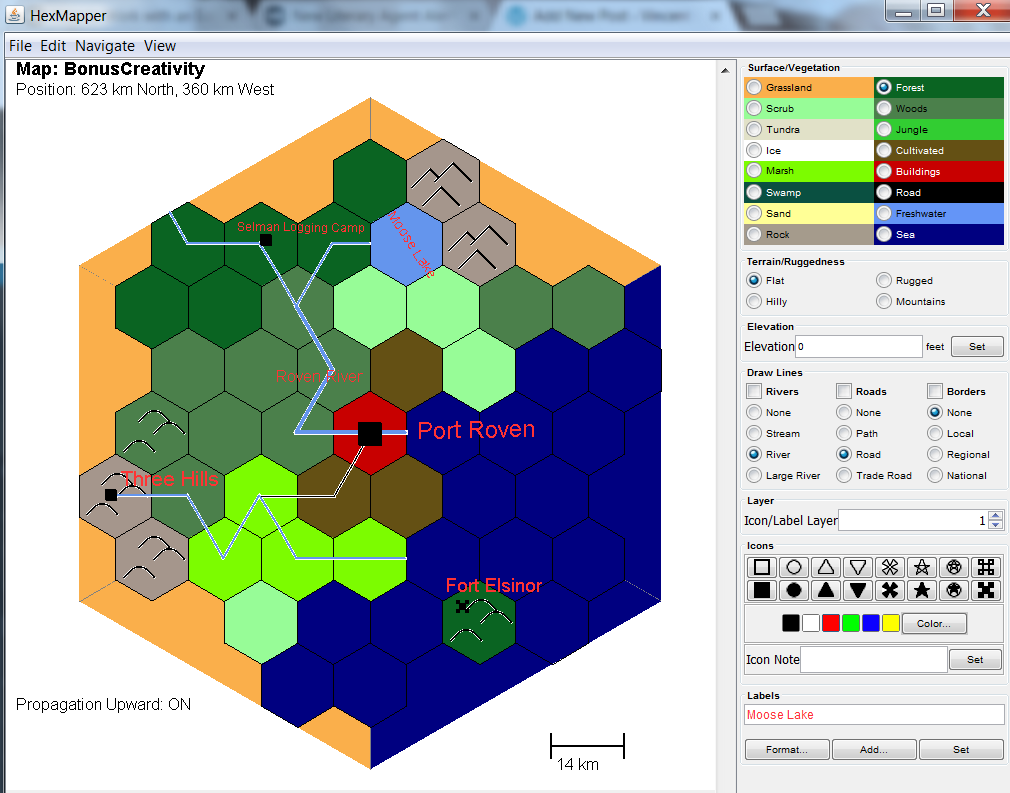
First, some basic amount of civilization. I figure I want a small city on the coast, perhaps a pair of additionnal settlement inlands. And why not a fortress on that island?

Beyond that, I add some basic geography. Some hills, some mountains, some waterways, and the beginning of a road. We end up with this beautiful landscape:

A fine start for a campaign. The players will start in Port Roven, with a few quest hooks available in town. I imagine I’ll go with some classics (like “goblins in the mines” or “protect the caravan” but I’ll also offer exploration opportunities (maybe go map the Roven River tributaries?) and perhaps some political chicanery (like dealing with a rival nation down in the southeast hex?)

Either way, it’s a start on the mapping front. I think I’ll work on detailing Port Roven next.

Just my Opinion: The Belisarius Series

I’ve re-read the first four volumes, and read the last two, of the Belisarius series, by Eric Flint and David Drake.

Overall, it’s an entertaining series. It covers a period of history and geographic locations that we don’t often get to see in movies or in book or TV series, and it manages to convey that feeling of authenticity you want from an historical novel without falling into the trap of endless descriptions or pontificating.

As alternate history, of course, we get a sci-fi veneer, but thankfully the authors manage to keep it fairly low-key. The focus is entirely on the in-period conflict; the bigger sci-fi framing story gets a few lines (if even that) in the first five books, and gets resolved almost as an afterthought in the epilogue of the sixth book.

Also… the series is blessedly short. Six short-to-medium novels, no dangling plot hooks, no unreasonable plot twists, and no long stretches of “well, here’s mildly interesting filler.” Sure, by the end of Book 4 you’re wondering how can the bad guys ever come back from the latest defeat… but unlike some other series I could name, by then we’re almost to the finish line.

And… this is the big one for me as a writer: the series ends well. Sure, it’s a happy ending, but what I mean is that the ending is well-paced, doesn’t invalidate the series conflict, but also doesn’t pretend that everything will be perfect forever afterward. It’s exactly the right amount of closure.

The series isn’t perfect. It overuses the same jokes over and over again. It doesn’t pretend the good guys are perfect, but the bad guys often fall into comic-book clichés or Chaotic Stupid behaviour. And there’s a distinct glint of plot armour on many of the main characters which got on my nerves at the end. Those are all small issues, however – the kind of thing I try to pay attention to, so that I don’t make the same mistakes in my writing.

But overall, it’s worth a read. Maybe not three or four re-reads, however.

And… that’s it for the Just my Opinion posts for a while. I’ve started on Proust’s À la recherche du temps perdu, which is fantastic so far… but oh god it’s seven volumes long!


Just my Opinion: Yeruldelgger

Yeruldelgger is a relatively recent, prize-winning French crime novel (it’s still commercial fiction, but apparently a good example of the genre.)

Here’s a confession: I don’t really like crime novels. After reading a few, they all sort of start to feel the same to me. Some reveal their villains early, other go for a twist. Maybe the villain escapes or maybe he doesn’t, there’s usually an incompetent or corrupt policeman, and so on and so forth. Most crime novels remind me of the standalone episodes of crime procedural shows.

And at the end of the day, most try to distinguish themselves with a gimmick. Some go for the torture-porn angle, others shoot for improbable backstories for their protagonist.

Yeruldelgger is, unfortunately, no exception (except it double-dips the gimmick) Gimmick 1: it takes place in and around Ulan-Bator, Mongolia. Gimmick 2: the main character has an implausible backstory (including time spent in a monastery and the tragic loss of one of his daughter.)

If you can get past that (and I could) – the book is decently well-written. It avoids relying on Parisian slang, and it’s short on magical coincidences (even though it at first seems to fall into that trap at first.)

Verdict? Tolerable airplane reading material, increasing to straight good if you’re a crime book fan. It’s definitely not worth learning French to read that though, but since we’re going to take a look at Proust in the coming months maybe get started on that anyway.

A Dad and a Writer: Month Nine

This month has obviously been easier for me, what with the whole “paternity leave” thingy. Then again, I was exhausted, so maybe it’s a wash.

On the baby front, it’s been a fun few weeks. Lots of small steps forward (that translate to a few more seconds of free time every day.) We’ve made the switch from formula to cow milk, my son can now sit up without support which makes bathtime less time-consuming, and so on.

I’ve been able to put in more time on the “becoming a writer” front as a result. Not as much as I’d like, because I wanted to give this blog more attention and because I’ve taken on some paying writing work, which means that Book the Second is still progressing at a snail’s pace.

But the real lesson of this month is the importance of setting up a writing schedule and sticking to it. It’s a good approach to writing in general, but it’s never so apparent that it’s really a necessity as when external pressures play havoc with your time.

Since I’m on vacation, I’ve allowed myself some time off. But my girlfriend also (rightfully) wants me to spend time with her. I’m also spending more time with my son… which means that my schedule has changed. And so, I end up wasting my free time on the Internet because it’s not my usual writing hour.

Still, progress is happening (and for what it’s worth, catching up on my sleep and taking some actual brain-resting time off does help with my productivity.) And each day brings me closer to the glorious first day of daycare!

Interim Query Report

Well, Book 1 hasn’t left for the self-publishing industry yet, but it’s getting its bags ready.

In the last Query Report, I had twelve live queries left. I added one a few days ago. But some of those queries are now obviously stale, others have been confirmed dead. So, as of today, I have six queries still live (some of which I’ll call dead in about a month, the rests are either still young or allow for a follow-up if I get no answer.)

All of those confirmed dead queries died by form letter. No request for manuscripts, no personalized feedback.

So that’s where I’m at. Frustrated, but still clinging to a forlorn hope.

Bonus Creativity: This Time, with Actual Maps!

Last time, we put down a few assumptions on our world. Before going any farther, I really do need to create the world’s geography, at least in broad strokes.

For that, I like to use HexMapper. It’s a free program with exactly as many features as I need. There are more powerful, more expensive options out there, but I don’t need too many bells and whistles. In any case, let’s fire the program and create a new world map.

Well… let’s create a reasonably-sized world. Five-meter hexes is way, way too high a resolution for a world map. And a world with five times the circumference of Earth and sixteen times the elevation is impressive, but perhaps a bit much for our purpose. As a matter of practicality, let have our gameworld-continent be, say, roughly the size of Europe (but stretched out, to allow for more climatic variations.) I figure 2000km by 5000km should be more than enough. So let’s create a 5000km by 5000km world, and let’s use the remainder as our ocean barrier and our “civilized, not used in game” continent.

Getting that actual world requires fiddling with the settings a bit, and I end up with a world built in four levels, with a base hex size of 300 meters. Let’s see what this looks like.

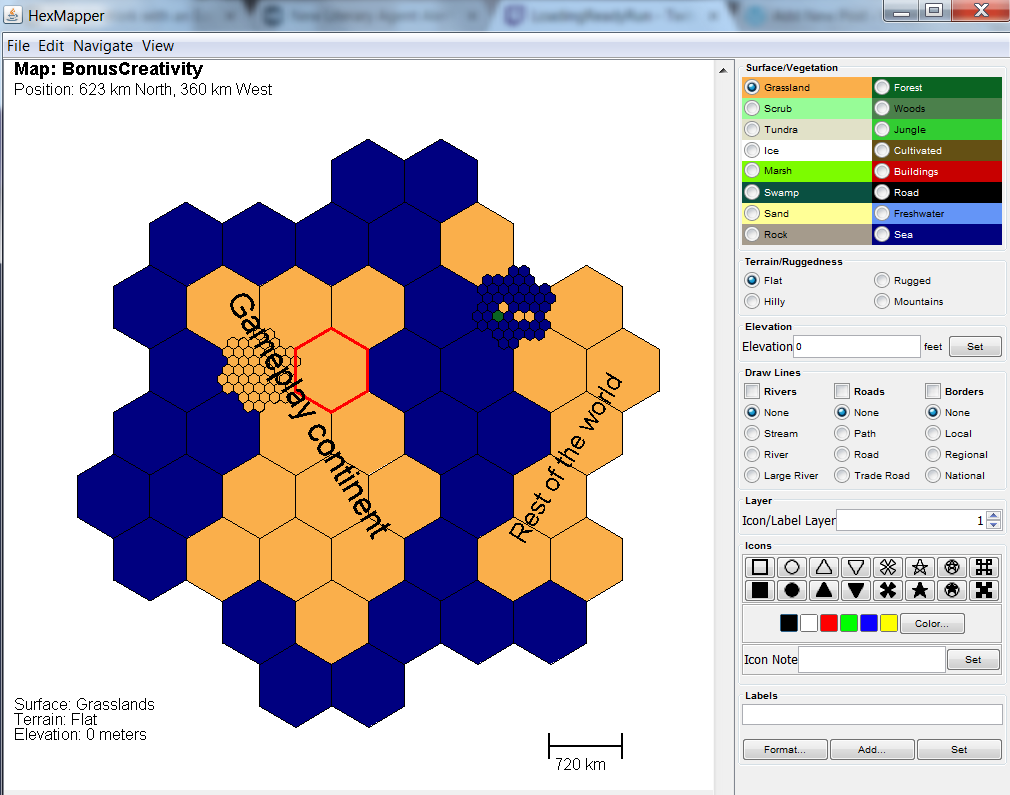
Well… that’s not very pretty, but it’s a start. Quick tutorial on HexMapper: currently, we’re looking at the entire world. It’s entirely made of grasslands. It’s possible to zoom into each of those hexes to see more detailed hexes, and down from there twice more until we reach the highest-resolution view (where each hex will be 300 meters to a size.) But to access those extra levels, we need to select hexes, use the Copy to Children option from the Edit menu, and then use the Down option in Navigate. Repeat ad nauseam.

Still, it means that we can build a world like we want. Let’s get started on the broad strokes.

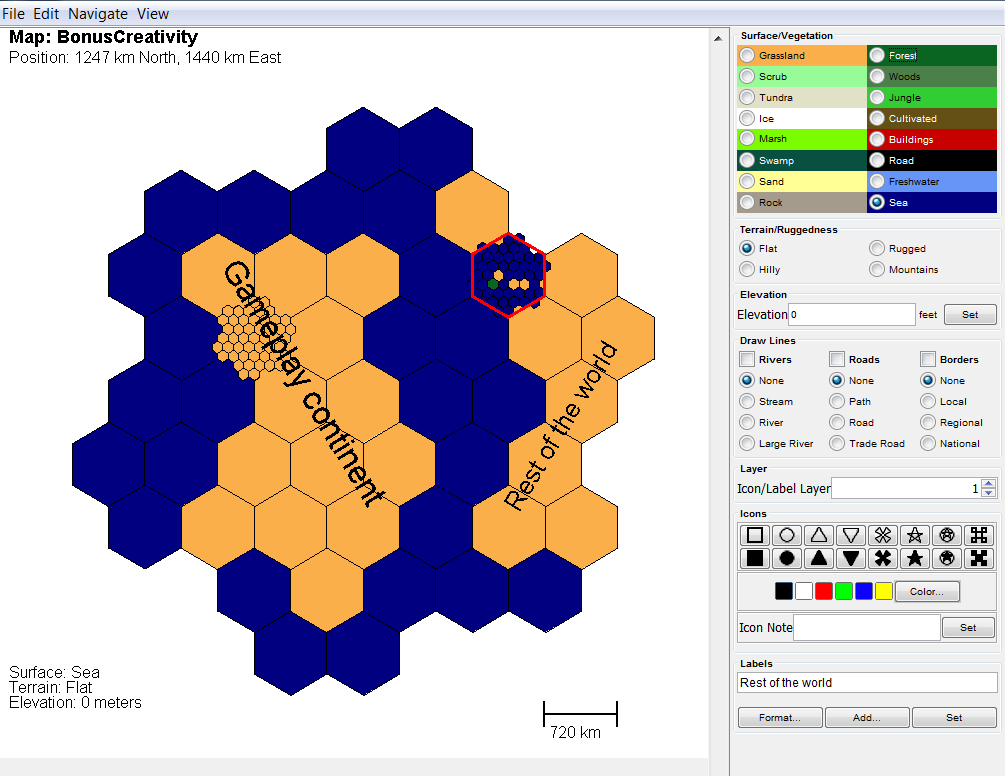
So that’s our world (helpfully labelled by the software) at the higher level, or lowest resolution. As we add in detail at the lower levels, the higher-level maps will adjust to reflect the changes. For instance, if I add a grassland-and-forest subcontinent at the second-highest level in the rightmost ocean hex in the third row, here’s how it’ll appear on our top-level map.

So that’s how we’ll build our maps. Obviously, doing every single high-resolution hex is way too much work at first, but we’ll take it one step at a time.

Next time, we’ll focus on one of those big hexes and start drilling down.

The Gameplan

Well, I’m on paternity leave. But I should have known that wouldn’t mean much more free time.

Objectively, I have about forty more hours per week. But I obviously wanted to spend some of that time with my son. We also had a fairly impressive backlog of household tasks that I had to get through. Plus, I’m apparently exhausted (surprising, I know) – I didn’t realize it in the high-speed grind of the work-fatherhood-writing lifestyle, but now that I have time to take it a bit easier, I’m barely making it through my days.

But if I want to accomplish anything in my remaining three weeks and change of “vacation”, I need to plan my workload out. So here we go:

1-Blogging:

My goal here is simple: two posts a week for the five weeks of my vacation. That should suffice to catch-up the few weeks I’ve missed this year, and to build a small buffer for emergencies.

There’ll be one Bonus Creativity post, one A Dad and a Writer, the Yeruldegger Just my Opinion, and at least one update on my queries. Beyond that… we’ll see.

2-Writing:

I sorely wanted to challenge myself to 300 words per day for the duration, but I’m just too exhausted. Instead, the goal is now “reach 8000 words in Book the Second.” I’m at slightly over 2000 now, so I feel that’s an achievable goal.

I also need to take an evening to work on the setting bible for Book the Second. I need to draw a quick world map, formalize how magic works in that universe, that sort of stuff.

As a tertiary goal, I really should write out a first version of the synopsis. It’s the kind of writing I could easily improve upon during my breaks at work. Plus, it’s a good way to spot any plot issues prior to writing out several thousand words.

3-Querying:

Well, I found one other agent which may be interested in Book the First, so I’ll query her in the next couple of days. Then I’ll spend a few hours reviewing the status of my last batch of queries. Except a query report at some point.

4-E-publishing:

As mentionned, I want to start looking at e-publishing Book the First. I need to do some research on that, so that’s likely to be the subject of a blog post at some point. Depending on the amount of work required to turn my manuscript into an e-book, I might want to get started on that during my vacation too.

5-Extra content:

I’ve got some ideas for additionnal material for this blog. We’ll see how that goes.

So that’s what I’m trying for in the next month or so. We’ll see how it goes.
Just my Opinion: Ulysses

How do you review something like Ulysses?

Even in this strictly informal, random-thoughts format, it’s a daunting task. I’ve started writing this post several times, only to delete my work because it failed to convey my meaning.

Let’s get the easy stuff out of the way first. Ulysses is not, by any stretch of the imagination, an enjoyable read. Don’t bring it to the beach hoping for an easy, relaxing afternoon: this is the kind of book that’s better read in a commented form (something which I should have done in retrospect.)

It’s pretty tough to describe how dense Ulysses can get. At times, simply following the plot through Joyce’s stream-of-consciousness writing is nearly impossible. So forget about catching all the the cultural and political references or understanding all the literary allusions and philosophical digressions.

In fact, despite being a voracious reader and a writer, I’d say I’m at the very lowest level of reading ability necessary to begin to understand the work. I certainly would have benefited from a few undergrad classes in English Literature (or maybe a Ph. D.)

But… I think I get it. Sorta. Maybe. By that, I mean I can appreciate some of what Joyce wanted to do. I see some of the stylistic choices, I perceive how they influence how we read and perceive the text.

Certainly, it’s the book I’m most glad to have chosen for this year. I’m sure I’m a better writer for having read it.

Next up – some very, very light reading.